
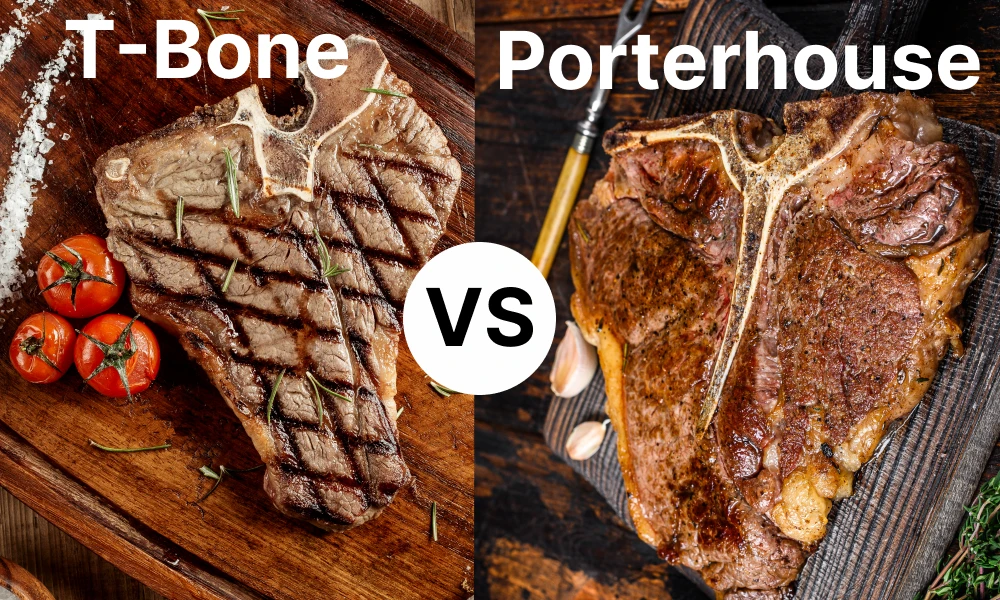
Ask five people to explain the difference between a T-bone and a porterhouse steak and you’ll likely get five different answers. It’s one of the most common points of confusion at the butcher counter, and the truth is, the two cuts are more closely related than most people realise.
This guide clears up the confusion for good, so you know exactly what you’re buying and how to cook it.
Are T-Bone and Porterhouse the Same Cut?
Technically, yes and no. Both come from the same section of the animal, the short loin, and both feature the same T-shaped bone with meat on either side: a smaller strip of tenderloin (eye fillet) on one side and a larger piece of sirloin (or striploin) on the other.
The real difference comes down to where along the short loin the steak is cut and, in turn, how much tenderloin is included.
The Key Difference: Tenderloin Size
- T-bone steak: Cut from further forward on the short loin, closer to the ribs, where the tenderloin section is smaller.
- Porterhouse steak: Cut from further back on the short loin, closer to the rump, where the tenderloin section is noticeably larger.
In practical terms, a porterhouse gives you a bigger piece of the prized, ultra-tender fillet in every steak, while a T-bone leans more heavily on the sirloin side.
Comparing T-Bone and Porterhouse Side by Side
| Factor | T-Bone | Porterhouse |
| Tenderloin portion | Smaller | Larger |
| Overall size | Slightly smaller | Generally larger |
| Price | Typically more affordable | Often priced higher |
| Best for | Those who mainly want the sirloin side | Those who want a generous fillet portion |
| Cooking approach | Same for both | Same for both |
How to Cook Both Cuts for Best Results
Because both cuts combine two different textures, fillet and sirloin, in one steak, cooking technique matters more than with a single-texture cut.
- Bring to room temperature for 20–30 minutes before cooking, since these are thicker steaks with a bone running through the centre.
- Sear on high heat first, 2–3 minutes per side, to build a good crust on both the fillet and sirloin sections.
- Finish over indirect heat or in the oven if the steak is particularly thick, to bring the centre up to temperature without burning the outside.
- Use a meat thermometer near the bone, checking both the tenderloin and sirloin sides, since they can cook at slightly different rates.
Target internal temperatures:
- Rare: 50–52°C
- Medium-rare: 54–57°C
- Medium: 60–63°C
Resting and Serving
Rest both cuts for 5–8 minutes before serving, allowing juices to redistribute evenly across both sections of meat. When carving, it can help to remove the meat from the bone first, then slice each side according to its own grain direction.
Which One Should You Choose?
Choose T-Bone If:
- You primarily enjoy the flavour of sirloin and see the fillet portion as a bonus.
- You’re after a slightly more affordable option without sacrificing the classic bone-in experience.
Choose Porterhouse If:
- You want a generous serving of tender fillet alongside your sirloin.
- You’re cooking for a special occasion and want the most impressive cut on the plate.
Neither is objectively better, it genuinely comes down to how much you value that fillet portion.
Why Grass-Fed Beef Makes the Difference
Whichever cut you choose, the quality of the beef itself has the biggest impact on the final result. Our beef comes from grass-fed and finished cattle raised on Western Australian pastures, free from hormones and antibiotics, delivering a cleaner, more distinct flavour across both the sirloin and tenderloin sections.
Browse our full Beef range to find the T-bone or porterhouse cut that suits your next BBQ or dinner. If you’re leaning toward an even bigger centrepiece, our guide on how to cook a whole porterhouse roast is worth a read too.
Final Thoughts
T-bone and porterhouse steaks come from the same part of the animal, with the main difference coming down to how much tenderloin each cut includes. Once you understand that distinction, choosing between them becomes a simple matter of personal preference.
Shop our Grass-Fed Beef range today and pick the cut that’s right for your next steak night.